
From Donated Equipment to Farm Automation: Cal Poly Students Enter Global Robotics Competition

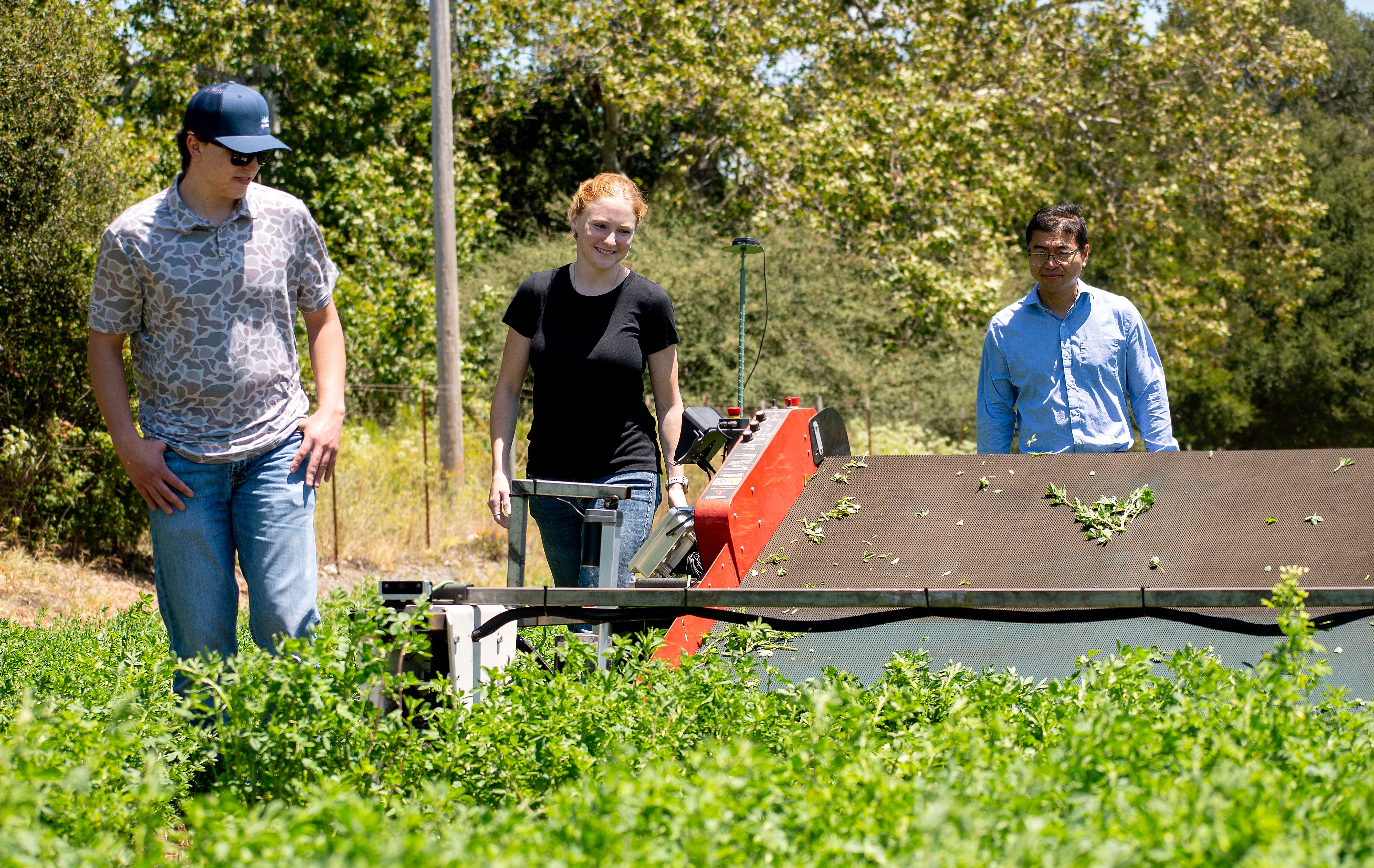
After several months of rewiring, troubleshooting and engineering, a team of Cal Poly students transformed a donated leafy green harvester into an autonomous farm robot and submitted it to the international Farm Robotics Challenge.
Anna Reed, a third-year bioresource and agricultural engineering major, has been involved with robotics since her freshman year at Cal Poly when a few Cal Poly seniors attended the International Forum for Agricultural Robotics contest. Since then, students including Reed have continued developing the project, which came to fruition this academic year.
With technology continually evolving and becoming more integrated into agriculture, farm technology has emerged as one of the most expansive and crucial sectors of the industry. The Farm Robotics Challenge is a global competition that welcomes agricultural innovation, dedication and learning into one space. Students from universities across the globe have the opportunity to put together innovative projects and teams are encouraged to tackle real-world problems while creating active solutions.
The Cal Poly Robotics Challenge team, composed of Reed, agricultural systems management major John Sullivan and civil engineering major Leah Gibbs, competed against teams from 13 countries in the 2026 Farm Robotics Challenge to build the next generation of farm technology. Each team is given the autonomy to decide what to build and the diverse agricultural industry presents a range of opportunities for innovation and technological advancements.
The Cal Poly team focused on improving produce harvesting by building an automated precision harvester for lettuce. The team used an Amiga robot originally developed by farm-ng, a robotics company based in Watsonville, California, that was customized into a functional automated harvesting system. “Being able to step back and really think about another way to do something or think about what may have caused a part to work once but not work again is truly something that I will take away and use in my future endeavors,” Sullivan said.
Components of the contest included a written report and video submission, highlighting the project and its features in its entirety. While the video showcased the machinery in action, the written report contained the more minute details, from the design to commercial viability and a cost analysis.
The team drew inspiration from a donated Terrateck RJP, a compact, walk-behind harvester designed to pick young leafy crops, along with the existing farm-ng base, an all-electric microtractor that can be adapted to a range of farming systems.
Earlier this year, the Cal Poly students traveled to Watsonville to meet with Bonsai Robotics, which acquired farm-ng in 2025. There, they worked with the team to update outdated control systems on the robot. Bonsai provided the team with temporary replacement hardware, including a new dashboard and pendant, while the company's technicians repaired the robot's original "brain," the main computer.
The autonomous harvester is the latest in a series of Cal Poly submissions to the competition. Reed’s involvement built on the work of students who came before her, and months of collaboration helped bring the machine to life. “I was a one-person team last year, so I wasn't going to get it done, for sure,” Reed said. With the help of Sullivan and Gibbs, the project gained momentum and was submitted to the Farm Robotics Challenge this spring. Although they didn’t win the competition, the lessons learned along the way will stay with them.
“My biggest takeaway from working on the autonomous leafy green harvester was learning how to apply concepts from the classroom to a real-world engineering project,” Reed said. “I gained a much deeper understanding of relays, Arduino systems and coding by using them to solve actual problems rather than just studying them in theory. The project also strengthened my troubleshooting and problem-solving skills. One of the most valuable lessons I learned is that setbacks can feel like walls at first, but with persistence and a willingness to keep testing and learning, those challenges can be overcome and often lead to a better solution.”
For Reed, Sullivan and Gibbs, this submission is not only a reflection of this year’s work but also a continuation of the work and dedication of the students who came before them.
Visit Cultivate Summer 2026 to read more stories.


