
Rooted in Resilience: Agave Takes Hold in California’s Thirsty Heartland

As water shortages reshape farming in the Central Valley, a Fresno County grower is betting on drought-tolerant agave and partnering with Cal Poly students to mechanize the harvest and spark a homegrown spirits industry.
As temperatures continue to rise and water scarcity grows in California’s Central Valley, some farmers are turning to a new crop to adapt to these challenges and stay in production. Agave, a drought-tolerant succulent native to arid regions and known for its large, spiky leaves, is emerging as a promising alternative to traditional water-intensive crops. The plant is also fueling a budding interest in California-produced agave spirits.
Stuart Woolf, a second-generation farmer in Fresno County, is one of a handful of people leading the charge. He started small, planting 5 acres five years ago, and that number has now grown to 550 acres with more than 600,000 agave plants. He has since become president of the California Agave Council, a non-profit trade association of California agave growers and processors established in early 2022. A vocal and passionate proponent of the burgeoning industry, he and his wife Lisa have invested in research at both UC Davis and now Cal Poly to further advance it.
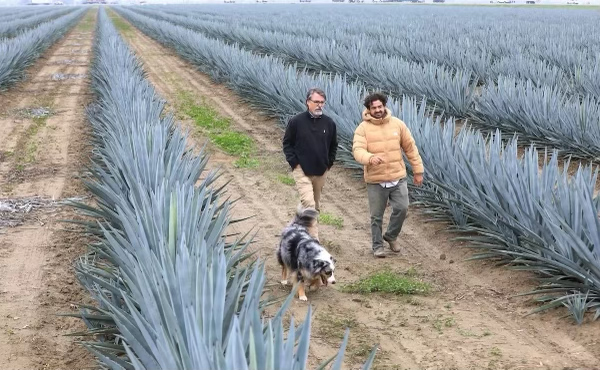
“We’ve been losing our water supply and I don’t want to lose our family land,” said Woolf, who is the chairman of Woolf Farming & Processing, a family-owned business focused on producing and processing agricultural commodities such as almonds, pistachios, tomatoes, grapes, onions, garlic and grains across six California counties. “I love the west side of Fresno County and when I drive around this ranch it is part of my family legacy.” Woolf added, “One night I was sitting at home sipping mezcal and thinking about what I could grow that doesn’t take a lot of water. I decided to look into agave.”
Woolf said that while early indications suggest most California agave plants mature faster, produce higher yields and contain more sugar — all of which bodes well for spirit production — the new crop is not without its challenges. The plants, typically grown in Mexico for tequila and mezcal manufacturing, have long maturation cycles and are a notoriously labor-intensive crop to harvest — requiring skilled labor to manually harvest plants that can weigh upwards of 200 pounds each. In Mexico, harvesting techniques have been passed down for generations, with agave harvesters, known as “jimadores,” using a razor-sharp, circular blade on a long handle, called a “coa de jima,” to cut the plants by hand. That same skillset is not readily available to California growers.
“Now we just need to figure out a way to reduce harvesting costs by automating the process,” Woolf said. He believes that Cal Poly students may be part of the solution.
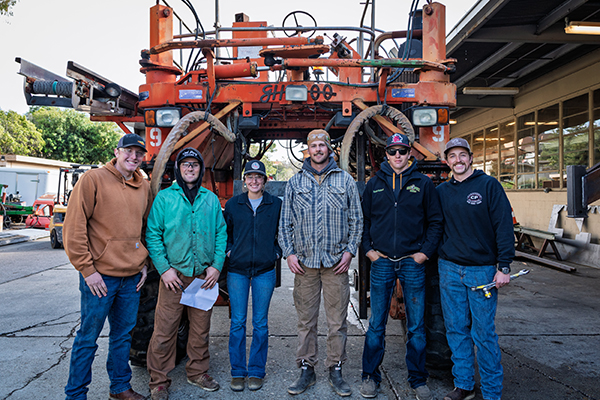
Woolf commissioned a group of seven students from the BioResource and Agricultural Engineering Department to develop an automated harvester for their senior project. In the fall the student team created a 3D model using CAD software to plan and design the harvester. They are now in the building phase, modifying a grape harvesting machine with specialized equipment designed to harvest agave, including a trimming head for the leaves. “The students are designing a machine that can remove up to 80 percent of the agave leaves and extract the plant from the ground,” Associate Professor Mohammad Sadek said. “It will significantly reduce the manual labor required during harvest.” Sadek is now seeking additional grant funding to support further research, with the goal of developing a harvester capable of fully automating the process.
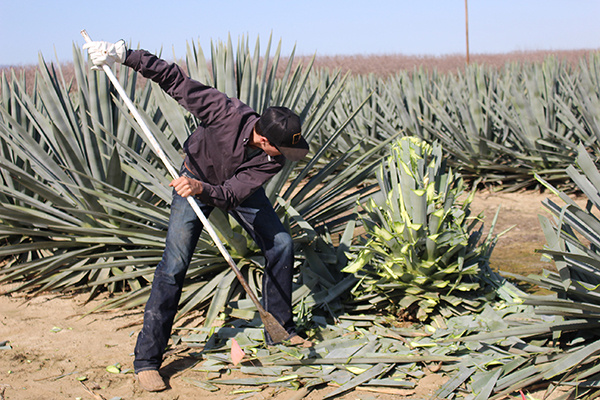
Woolf recently invited the senior project team to his farm in western Fresno County to better understand the crop. They spent the day becoming familiar with the large, unwieldly succulents, including trying their hand at harvesting. “They are big, absolutely huge. And the minute I got out of the truck they stabbed me through my jeans,” laughed fourth-year agricultural systems management major Carson Stueve. “We were only able to harvest eight of them in about four hours.” The trip solidified their resolve to build the mechanized harvester.
“We’ve removed the grape harvesting equipment from the unit we are modifying, so it is essentially a large hydraulic powered machine on wheels that we can adapt as needed,” fourth-year agricultural systems management major Brock Robertson said. Factors include recognizing that each plant varies in shape and size and that the best quality harvest results depends on the precise removal of leaves to expose the piña — the agave’s large central core harvested for its nectar. “We are designing it so that it can be customized as needed moving forward. This is a good investment if you are looking to bet on the future of agave.”
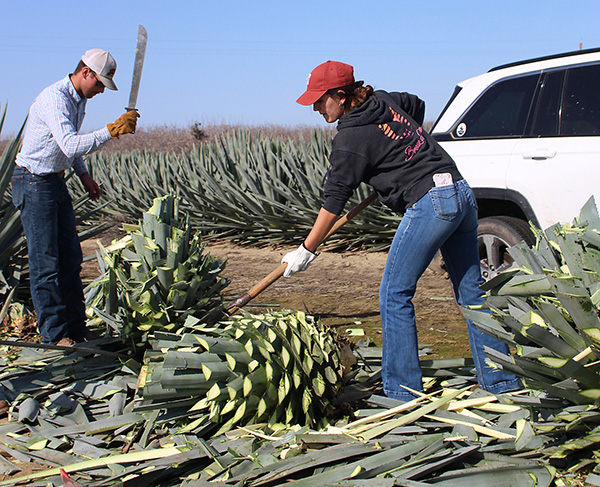
Woolf spent the day in the field with the students, mentoring them and sharing his knowledge of the crop. “I’ve hired a number of Cal Poly graduates over the years and know the value of the Learn by Doing education they receive,” he said. “The enthusiasm these students bring to this project matches the transformative vision behind what we are doing with agave. Never in my wildest dreams did I imagine how much land here would be fallowed due to water shortages. This is how we can begin to breathe life back into the rural communities. It’s my dream that one day Western Fresno County could be the Napa Valley of agave.”
Visit Cultivate Spring 2026 to read more stories.


