
Where Innovation Takes Root: Automation in Action

Fourth-year agricultural engineering major Anthony Leung is helping tackle a challenge facing California agriculture: reducing chemical use while giving growers the tools they need to operate more efficiently.
Inside the newly opened Marderosian Family Foundation and Bee Sweet Citrus Automation Lab, Leung is developing and improving a variable-rate sprayer for vineyards that uses cameras, artificial intelligence and sensors to detect grapevine foliage and adjust chemical applications in real time.
For Leung, who grew up in San Mateo with little exposure to agriculture before coming to Cal Poly, the work has also transformed an interest in engineering into a potential career focused on the future of agriculture.
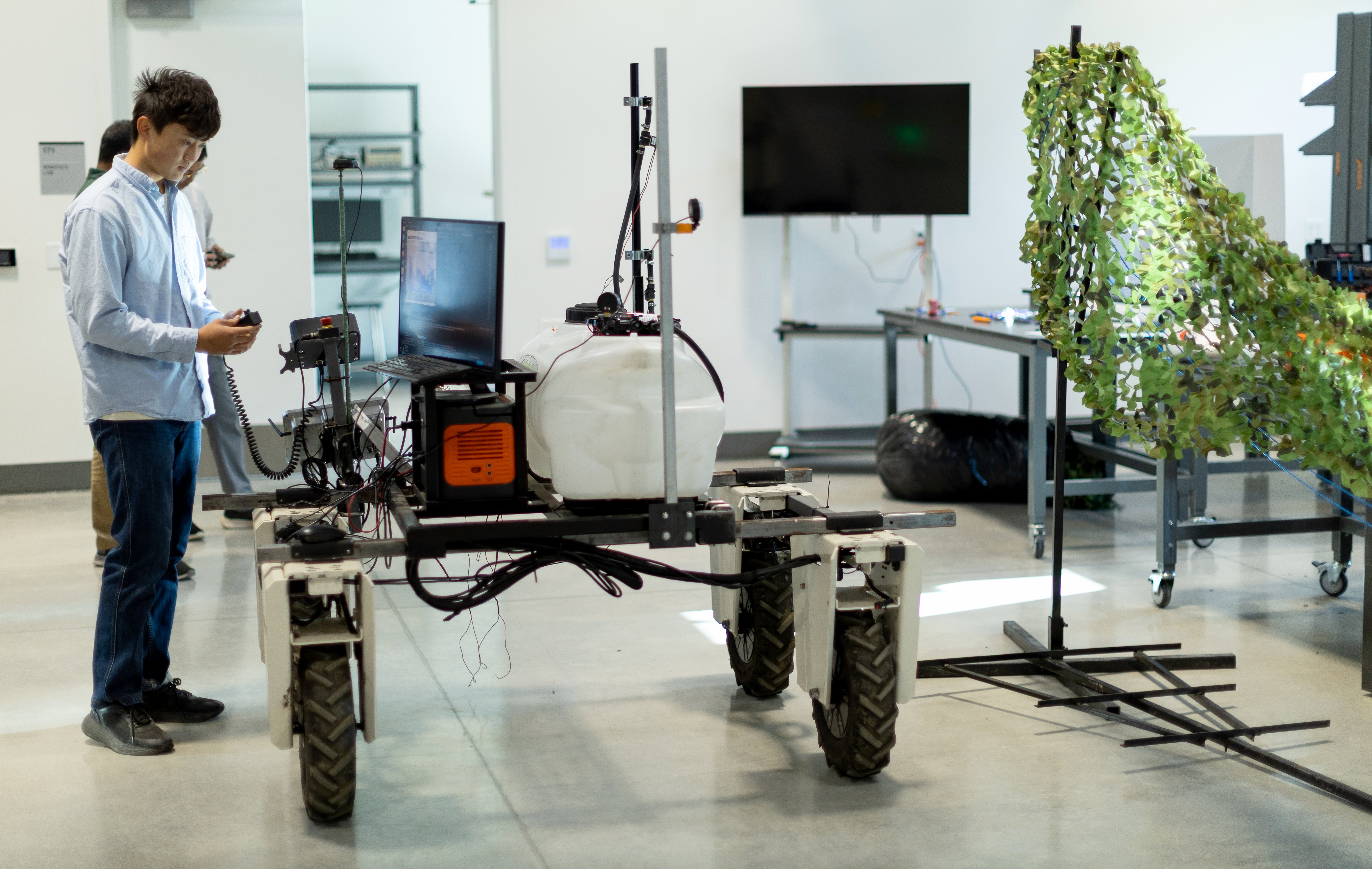
Leung is now one of more than a dozen students who can be found each day working on various automation projects in the newly opened Marderosian Family Foundation and Bee Sweet Citrus Automation Lab. The state-of-the-art lab provides space for students to design, build and test robotics, hydraulic systems, sensors and other emerging technologies, preparing them to address real-world industry challenges.
Leung’s current research project, funded by an Agricultural Research Institute grant and overseen by Professor Bo Liu and Associate Professor Mohammad Sadek, is focused on developing and improving a variable-rate sprayer for vineyards. Vineyard operators use sprayers to apply insecticides and fungicides to grapevines.
“I chose to major in agricultural engineering because it sounded interesting,” Leung said. “I wasn’t sure what I wanted to do at the time, I just knew that I liked engineering. I felt right at home in the classes, and after talking to a lot of industry professionals, I learned about the high demand for precision agriculture, especially in California, where labor costs are high.” He is now considering starting a business after graduation to help meet that demand.
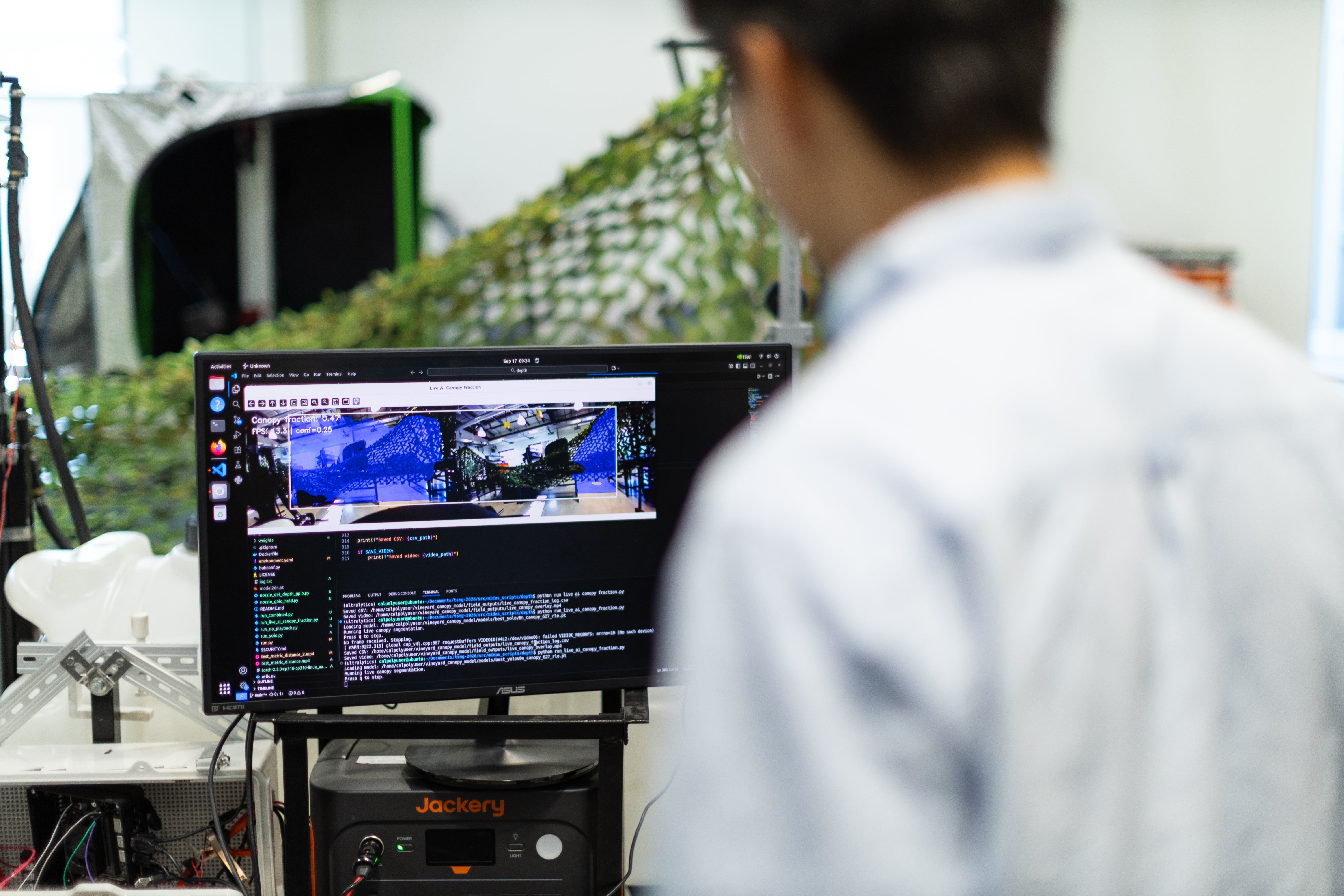
Leung looks forward to the research, getting up early most days to spend a few hours in the automation lab before attending classes and returning later in the afternoon. The goal of the project is to improve on standard constant-rate sprayers that deploy a fixed amount of chemicals, regardless of the density of the vines. Using cameras, artificial intelligence and sensors such as LiDAR (light detection and ranging) technology, the prototype is being designed to detect the exact presence, height and density of foliage in real time. The sprayer then automatically adjusts the application to meet the density of the grapevine canopy in front of it. If there is a gap in the foliage, no spray is emitted.
“The project directly aligns with the need to reduce waste and the emphasis, especially in California’s laws, to reduce chemical use with all agricultural crops,” Sadek said. “Projects like this one give students the opportunity to have hands-on experience building solutions for current industry needs.”
Both graduate and undergraduate students are immersed in research projects in the automation lab. They have dedicated workspaces with tools nearby and are able to come and go as their schedules permit. Other projects underway include automated harvesting equipment for lettuce, broccoli, table grapes and agave.
The experience has given Leung the opportunity to expand on everything he has learned in his classes and pushed him to think beyond the scope of typical classwork. “I have very high ownership of this project as an undergraduate,” Leung said. “I had pretty limited design experience [prior to this experience] and I have definitely learned a lot. To be able to understand and create a product by myself and learn how to build it from the ground up is an experience I’m not sure I would have gotten outside of Cal Poly.”
Leung’s experience highlights the goal of the automation lab, Sadek said. “The lab is designed to provide the various industries within agriculture with more optimized solutions, while giving students the hands-on experience with active projects that help growers and farmers.”
Visit Cultivate Fall 2026 to read more stories.


